
Introduction
Are we on the brink of an AI-driven SEO revolution, or is this just another wave to ride in the ever-evolving digital ocean?
Ann Smarty Biography
Ann Smarty, a veteran digital marketing strategist and SEO expert with over 20 years of experience, joins us in today’s episode. Ann:
- Is currently active on Twitter and LinkedIn
- Has been a leading voice in SEO strategy and digital marketing
- Hosts weekly live videos sharing invaluable insights with her audience
Episode 6 Summary
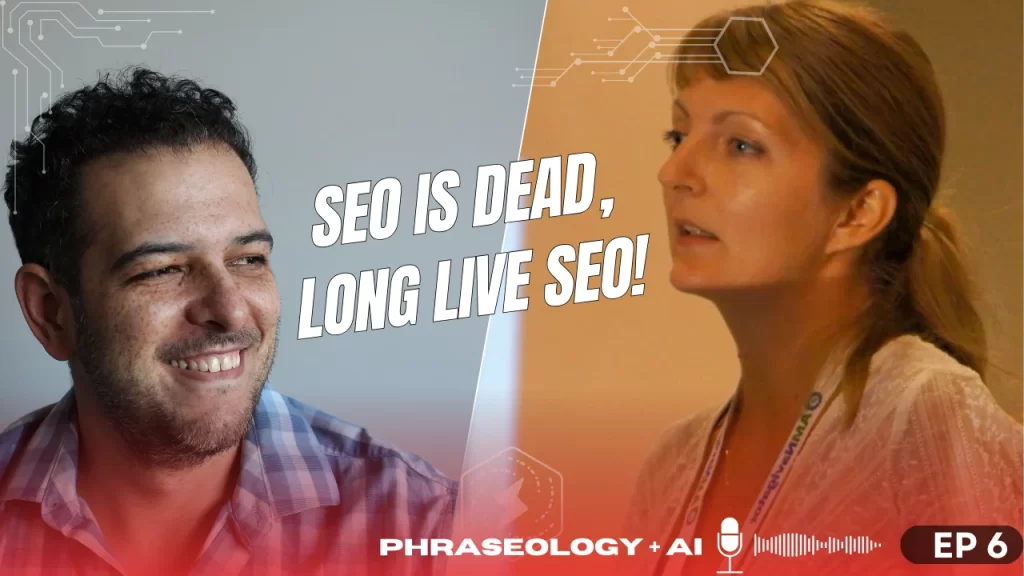
In this episode of “The PhraSEOlogy + AI Show,” Ann Smarty delves into the profound impact of declining Google traffic on publishers and e-commerce businesses and the pressing need for agility and continuous learning in the SEO landscape. Filipe Santos and Ann explore the far-reaching implications of AI in marketing, from the gradual shift in user behavior to the emergence of new discovery channels. They also caution against the quick rollout of generative AI platforms like SGE and Copilot, emphasizing the need for effective control and optimized use of this technology. Ann encourages a diversified approach in SEO, shifting focus from mere keywords and link-building to comprehensive strategies incorporating content creation, community engagement, and PR.
Additional Resources
- Connect with Ann Smarty on Twitter and LinkedIn
- Ann Smarty’s live videos and content: Ann Smarty Weekly Videos
- Learn more about AI tools mentioned:
- Gemini
- Chat GPT
TL;DR
- Google traffic for publishers and e-commerce businesses is on a long-term decline.
- AI adoption in marketing is slower than expected and more impactful over time.
- The launch of SGE could drastically affect quick answer search traffic.
- AI tools like Gemini can significantly enhance content creation and productivity.
- The future of Google’s algorithm remains uncertain but challenging for SEO strategies.
Episode 6 Transcript
Filipe Santos
00:00:00 – 00:00:40
Is your SEO strategy stuck in the stone age? Maybe having search engine nightmares? Forget wearing a black hat. The catch 22 is that AI is rewriting the SEO rule book. We decode the future of search and unlock the secrets to dominating AI powered rankings with Anne Smarty. Buckle up, SEOs. The future is here. This is phraseology plus a I with your hosts, Felipe and Miguel Santos. As a digital marketing professional specializing in SEO for over 20 years, I’ve worked with companies from startups to the global Fortune 500. Learn how to gain an unfair advantage with AI as we uncover tips, tools, and strategies.
Filipe Santos
00:00:41 – 00:01:44
I’m excited today to welcome Anne Smarty, a renowned digital marketing strategist, SEO expert, speaker, and educator. With over 2 decades in the profession, full of experience, Anna is dedicated to helping businesses harness the power of organic search to drive growth and to enhance brand visibility. Her expertise in crafting comprehensive SEO strategies and kind of creating compelling content, translating insights into actionable results has led to really amazing achievements in in the industry and with our clients. Anne’s impact is undeniable here with a commitment to continuous learning and a track record of viral content campaigns and as a go to expert for all things digital marketing. But I I’ve known her in SEO specifically, but everywhere, I think, in digital marketing. So don’t miss this opportunity to gain really strong insights into everything digital marketing from a true industry leader. With that, I would love to, like, pass it over to you, Anne, to talk about anything that you are up to and, like, a little give people a little bit of your background to hear from you.
Ann Smarty
00:01:44 – 00:02:06
Wow. What an introduction. Thank you so much. I’m I’m humbled, and I’m not as good talking about myself as you were talking about me. But just a few words. Yes. I’ve been in the industry for for about 20 years. And I think the most important thing is that I’ve seen it all, and I’ve changed so many roles while I was there.
Ann Smarty
00:02:06 – 00:02:30
I was reporter of an SEO. I was editor in chief. I was community manager. I was founder. I was all of those things simultaneously and 1 by 1. I was an SEO analyst for the whole time and link builder and guest poster and so many things. I’ve seen it all. So, yeah, the feeling of being, like, a veteran is not the best one.
Ann Smarty
00:02:30 – 00:02:38
But, yeah, I am 20 years from beginning, and I’m still I’m still here. Thank you for having
Filipe Santos
00:02:38 – 00:03:10
me. Affiliate, don’t count yourself short. Even even though it’s been a long time, you keep fresh on everything, and I know that you’re out there, like, really keeping a a tap of everything that’s going on. So really, again, amazing having you here, and I think everybody will benefit from this conversation. Change is inevitable. We step onto the ever evolving digital stage where basically algorithms are reigning supreme. AI get it coming into the mix here. This dynamic arena is basically a battle for online visibility, and that is really raging, especially as this new contender has emerged.
Filipe Santos
00:03:10 – 00:03:36
Join us through this talk and this discussion about, different things that are related to everybody in marketing, SEO, and entrepreneurship as we embark on a journey to unravel the intricate dance between AI, SEO strategies, and uncovering the challenges that lie in wait along with the boundless opportunities that we will unveil. So, Anne, how do you think AI is evolving and layering into search engines as search results continue to be reshaped?
Ann Smarty
00:03:37 – 00:04:46
So one thing that I would like to mention here that this this is not you, and Google has been implementing AI and machine learning in their algorithm for about 10 years now. I think it’s since at least 2015. So it it has been there for a while, and we’ve been seeing those, impacts from that for a while as well. And there was an interesting conversation just a few days ago about, like, a few former Google engineers came out saying that there are so many layers of AI at this point in the algorithm that they there’s no one there’s no human being that can debug that, that can understand what is really going on. That’s that’s the huge impact of AI search engines. And they many of those people do not think that’s a good thing. And I personally also do not think that is the best bet the best thing in the world. And I think that even the helpful content why Google cannot really explain to us what it is and what it wants from us, it is because it is 9 90% of AI doing something, and no one knows what exactly.
Ann Smarty
00:04:46 – 00:05:03
So that’s that’s the reality of Google at this point. And the good thing though is that there is no killing Google unless they do it themselves. So they will either die or improve. So there is no other there is no other solution for them. So we will just wait and see.
Filipe Santos
00:05:04 – 00:05:11
You mean there’s no on and off switch somewhere in the background that every all all clients kinda mentioned, like, then we will take change everything for them?
Ann Smarty
00:05:11 – 00:05:39
Everything. Never been. Never been. But yep. I think that is, well, at least not that anyone knows. Maybe it will AI will evolve to a point when they where it can rule search engines on its own without any human help. But now for now, there is, like it’s too complicated even for those who created the algorithm and those who manage it. So not talking about SEOs as well, but we will see.
Ann Smarty
00:05:39 – 00:05:48
I feel like that there it’s either it’s either will kill Google, like I said, or it will have to improve and evolve beyond what it is right now.
Filipe Santos
00:05:49 – 00:06:12
Love that. Yeah. I mean, I always think about them as a business, and obviously we want to think that they’re unbiased and they’re delivering these great results because they really want to help people. But at the end of the day, they’re a business, so they need to survive. They’re gonna figure out some way to do it. And if not, then they get displaced kind of like Kodak when digital cameras came on online. So it’s just I feel like it’s the same. I love that perspective.
Filipe Santos
00:06:12 – 00:06:28
Kind of stemming from that then, could you tell us a little bit more about these the Google algorithms that you know of and, like, basically, how that’s evolved to incorporate AI and machine learning more to to impact the search results that we see today. I know that you kind of mentioned it a little bit, but maybe go into that a little bit more.
Ann Smarty
00:06:28 – 00:07:34
Yes. Absolutely. And going back to the discussion that I mentioned, back in 2015, the head of search that was the best head of search Google ever had was saying that we they did not he was opposed to implementing a any deep learning at AI into the algorithm for that exact reason that it it will be uncontrollable by human beings. And after he left, there were a few more heads of search, and that was if with every new person in that department, the more and more AI was implemented. And to this point, that’s why they’re a little bit lost as well with all those updates. And I feel like that’s the reason why they cannot explain to us what really what they want. And if you search Google, and I’ve seen that a lot, it’s it’s turning a little bit into chat GPD. You know, like, there isn’t a popular joke that Chargebee is, like, mainsplaining everything, saying the obvious things with with very confident, perspective on that.
Ann Smarty
00:07:34 – 00:08:11
And Google is pretty much the same. It’s turning into the same thing. If you try to search into something very specific, the results will be very generic and well well, very high level. It is very hard to get very specific questions from Google these days. And I think that is AI interpretation of queries that we type of search results of such documents that are in the index. If you read SGE and if you’re part of that experiment, it is going public anytime soon. That’s the same thing. They they state the obvious things that is very hard to get very difficult answers from Google these days.
Ann Smarty
00:08:11 – 00:08:58
It’s all generalized. And I think this is exactly the impact of AI and how AI is interpreting what we’re trying to tell. If you’ve ever had a long conversation with Gemini or Chargegbt trying to get them do something and explain to them what you want from them, and they will apologize and do exactly the wrong thing again in very high level, very very obvious answers and not exactly what I want. Sometimes I repeat myself a few times and to in in an effort to get, specific answers. That’s the that’s the problem with both Google and Generative AI at this point. It is very hard to get specific answers. It’s very high levels. Almost like they are targeting very clueless public, like, audience that does not know what they are typing, what they really want.
Ann Smarty
00:08:58 – 00:09:39
And they always explain, like, it’s definitions, why, how, listicles. That’s all you get from search results at this point. And this is the same the same problem that I’m having with any generative AI platform as well. And I think this is this is the AI impact. Not that AI is not going to evolve as well and better. I do trust that we’re just at the very beginning of that technology even though it has been around for for a few years. Like I said, it will be it will be getting better, but they’re just not there yet. But the impact on ours on the search results and the, generated platforms is obvious, And it’s not it’s not for the battle.
Ann Smarty
00:09:39 – 00:09:41
At this point, it’s going to change, I think.
Filipe Santos
00:09:42 – 00:10:36
You know, that’s super interesting because if you think about the last 5 to 10 years, honestly, I think companies, businesses, even teams have been focused on getting there fast. Right? Being rapid, like, being lean, thinking about ways to to make more money with less and do all that stuff. It kind of feels like that was the precursor for this because should we have really rolled out generative AI so quickly? Should we have waited till we understood better how to control the technology? One of the key aspects that you mentioned here is, yes, if you ask the same question 4 different times, even if you if you leave them exactly the same, you get 4 different answers. That is that really the best way to control your experience and use AI for smarter things? I’m not so sure. I mean, it’s it’s amazing technology. It’s I understand how it works. It’s great that it works to some degree. But, yeah, it’s it’s gonna change behaviors and behaviors change.
Filipe Santos
00:10:36 – 00:10:43
And then if the technology hasn’t gotten to a point where we need it to be, then it’s gonna be a little tricky, right, on navigating those waters.
Ann Smarty
00:10:44 – 00:11:28
I know. Yes. It is it is a time balance. I think that was, you know, in better form when it was launched when it is now. For some reason, I think it it’s being controlled, and it for that reason, it’s not giving it’s not performing as well as it should have been. So it’s somehow it’s being it’s being limited at for some reason. But going back to Google, that’s where the risk was. I’m okay with launching and, like, startup that is developing as we’re watching, but search engine the Google search engine was very well developed and integrating AI into the existing mechanism, and it was already very complicated.
Ann Smarty
00:11:29 – 00:12:40
And now they have layers and layers of AI as well, which no one can that was, I think, not the best decision because what they’re seeing now is a total collapse of searches out quality. I don’t know how how many people experience that, but, well, all I see is, like, listicles from high authority domains that have nothing to do with what I was with with with what I wanted to to find. And I have to use all those advanced operators like these quotes and to try to force Google to include my specific need into the search query and results because it’s almost impossible to convince Google to find something not obvious and not hosted on some huge domain that is not personal experience. Nothing that Google is trying to do is accomplished well. So we will see. I do feel like it’s going to change, and I do I’m I’m very well optimistic. I know there are a lot of good publishers who who were impacted by helpful content update dramatically and did not deserve it. And I feel like it’s it it has to change.
Ann Smarty
00:12:40 – 00:12:56
We just need to to wait for Google to figure it out because, like I said, it will only get worse or it will just change. That’s that’s the only 2 solutions that Google is facing, and we will see what whichever they will go.
Filipe Santos
00:12:56 – 00:13:18
Well said. Well said. And you actually had me reminiscing for a second there thinking about the, like, old days when you have to use the operational modifiers to be able to get what you wanted because it was kind of challenging unless you knew the specific phrasing to get there. And then as Google understood context a little easier, and now it’s kind of gone backwards a little bit, but I guess every new technology
Ann Smarty
00:13:18 – 00:13:45
It’s that it’s difficult. It’s definitely difficult than what it was. I remember the days when it was exact keyword matching. So unless you know a keyword, you did not get there. Yes. We were there as well. Now it’s almost like whichever keyword you’re using, Google almost knows better what I want. So the results will be not necessarily relevant to what I meant because they interpreted my query, my very specific very, very specific query.
Ann Smarty
00:13:45 – 00:13:58
They interpreted in in a generalized way and gave me something that I really know already, and that’s not what I needed. So, yeah, it’s it’s a different problem to tackle now than it used
Filipe Santos
00:13:58 – 00:14:29
to be. Now you you’ve obviously mentioned and obviously seen a lot in your career. No doubt. But, like, these these new generated responses so we talked about SGE a little bit. Have you had a chance to, like, compare it with, like, Copilot and, like, maybe what what do you think other well, there’s there’s, obviously, like, Chat GPT, Cloud, and others that are are out there. But in terms of search engine specific integrations or features within for generative responses, have you noticed them to be kinda similar, or do you think it’s just Google that’s kind of doing things a little aggressively and then kind of messing up the quality of the results?
Ann Smarty
00:14:30 – 00:15:19
I think SGE is not absolutely not there yet. Copilot is much better. One problem with SGA is exactly that the problem Google had with fluff content that they were trying to remove from search results. Now they added their own fluff con content because SGE gives answers that are not useful or helpful. For example, if we search for something like green Halloween costume, the answer would be green Halloween costumes are so bright. They are so good Halloween. The thing is, like, nothing that not not exactly well, there will be more there will be a custom ideas below that fluff. But, anyways, SGE, in my perspective, is not a good product yet, and they have been working on it for a few months now.
Ann Smarty
00:15:19 – 00:16:06
So if they if they launch it, they they they say that the feedback is good. I I don’t know who those people are they asking. They I I’m I know I don’t know a single person who, like, how SGE works and which answers it gives. But I feel like it’s it’s a inferior product to what others are doing. Even even Gemini is better in many ways. So but I feel like it’s too expensive to to give to integrate to integrate something very advanced in search result because imagine how each search would cost them if it’s if it’s a huge product. So they, they try to work around that. What they do is summarize search results so they’re not exactly going back to their knowledge base or anything.
Ann Smarty
00:16:06 – 00:16:36
They just summarize whatever search results, like, even them. So it’s easier. It’s faster. It’s, doable in cost perspective, But it’s not good. That’s that’s my problem with it. It’s in many ways, it’s not helpful. And not giving enough citations is dangerous to especially for health industry. They would claim something without referencing the source, or they will highlight the Reddit threat for things like what are the first signs of cancer.
Ann Smarty
00:16:37 – 00:16:53
So it’s it’s it it has been a lot of problems, and I’ve seen it, and I’ve seen people discussing it. A lot of weird examples of what it is what it is doing. So I feel like it’s not there yet even compared to any other AI solution out there, including Copilot.
Filipe Santos
00:16:54 – 00:17:10
It it’s interesting that you mentioned that because we always we always wondered what would bring Google down. And this is kind of, like, the first risk that I think, you know, I’ve seen and maybe the industry has seen in a while, like, a real risk, to their business. So, yeah, kinda fascinating to watch this.
Ann Smarty
00:17:11 – 00:17:49
We’ve been saying that we’ve been saying this in our industry for years. Like, there is no single company that can, win Google that we’ve taken down or, like, do anything with it. Only Google can ruin itself, and that is what is happening right in front of our eyes. It’s not going to be fast. It it will it will I feel like we have another decay to watch Google falling. Right? Remember what happened to Yahoo? It was, like, exactly about 10 years that they were going down and down. So it will not be, like, one day thing. We will still be able to adapt and find other, channels to for visibility.
Ann Smarty
00:17:49 – 00:18:02
And, of course, there will be other search engines, not one, not a single one, but several, which is a good thing. So if it but if Google continues to follow this, route, I feel like it is going down.
Filipe Santos
00:18:03 – 00:18:35
Yeah. Yeah. Well, we can only kind of watch and kind of see the indicators as as we as we go through our experience. But, I mean, that’s a perfect segue into, like, a little bit more discussion around the importance of understanding these AI driven algorithms because we still have to work with them. There’s no putting the genie back in the bottle. Right? So how exactly do we focus our SEO strategies for the most effectiveness that we can versus, like, the way that we’ve done it in the past given the the new landscape with AI? Like, how do we how do we navigate that? What do what’s your opinion on that?
Ann Smarty
00:18:35 – 00:19:23
Well, my opinion is that fundamentally, it is not as different as with optimizing for search engines. AI is using what we do, what we talk about, what we write about. They that’s what they’re using. They don’t have any other information. So branding, building your brand, being out there, viral marketing, marketing, social media marketing, any brand mentions, product mentions, product reviews, all of that is going to be just get people talking about you. It has always been a great strategy for Google, and now it’s going to be the same for AI. Like, I started my agency in November, and I started being more active on social media. And guess what? I, when you ask, top, SEOs worldwide in I think it was.
Ann Smarty
00:19:23 – 00:19:55
I don’t remember. Someone showed me the screenshot. Maybe that was Bing’s chat, but probably the same thing. So when I when I asked that, that’s when when I started being active and getting my name out there. I got put in that list as well. So it’s it’s exactly what, they are using. They need other people talking about you, you being more active. You have your absolutely having your website because if there is any reference, if there is a connection, they need some something that they can reference you or talk about you and reference with that with some entity.
Ann Smarty
00:19:55 – 00:20:54
So it’s building website, getting your name out there, getting links, getting mentions, building your brand, creating content that solves solve something that people are going to ask, in charge of video or quote or whatever. So it’s all it’s it’s the same thing. It’s just I think branding is getting a little bit more important. Not that it wasn’t essential previously because it is a huge signal for Google as well. It was just not easy to explain to clients why they need to become a brand and why they need their brand mentions. Now I think, like, if people start using generative AI more, it will be easier for us to say, hey. This is why you need to to to be active on social media or let us create battle campaigns for you or get you, like, influencer marketing, whatever you can to get your name mentioned more and linked more, product mentioned and reviewed. All of that is going to help, AI in AI visibility just like in search engines.
Ann Smarty
00:20:54 – 00:20:55
It’s helpful as well.
Filipe Santos
00:20:56 – 00:21:10
That that’s excellent. What’s interesting regarding that, so it’s not that it’s it’s changed a little bit, but it’s still the same principles as I have always been there. So it’s just that now it there’s more urgency around it. Right? Around doing the right things.
Ann Smarty
00:21:10 – 00:21:49
Even like technical SEO, generated AI is very actively using schema, for example. So one of the one of the first steps to optimize your site for for that for those platforms is to use as many as much schema as you can because it’s not just Google supported schema now. It’s more like you can you can go ahead and you find what you need. And there’s huge documentation, and you can explore it and encourage everyone to do that because, platforms like ChargePD are also very schema friendly. They’ll love extracting information from schema. And that is that is this is something everyone should be doing right now.
Filipe Santos
00:21:49 – 00:22:13
Do you have some actionable tips for folks that are listening in terms of adapting their SEO strategies? I know we talked a little bit about how they could be effective with them, but are there, like, specific tips that you would really give to the, let’s say, the mom and pops or the the smaller players, the smaller people out there that are just trying to, like, understand how to break the paralysis of, like, being in a competitive more competitive space online and for visibility?
Ann Smarty
00:22:14 – 00:22:58
Well, first of all, it’s going to be different for every business. And, like, just like with search results, moms and pops are already not feeling that well, and that has been around for 10 years. So we will have to find low hanging fruit opportunities for every business out there. For example, if it’s a local business, then local marketing is something they need to be focusing more in terms of getting reviewed, getting all those Yelp mentions, citations, and all those things. So it’s it’s it it is going we had we had a very small not client, but lead that never became a client, but they produce a very specific product for sailboats.
Filipe Santos
00:22:59 – 00:22:59
Mhmm.
Ann Smarty
00:22:59 – 00:23:38
And they didn’t have much budget as well. So we were just brainstorming with them what they can do, and they’re like, did you try YouTube influencers? Like, go ahead and try ask them to try your product and just review it. And they they are all they are also huge. They do not respond. And my idea was do not go to hugest guys. Do not go to after hugest channels. Find those enthusiastic YouTube channels that not picture, not joy like a beautiful life on a sailboat, but actually share the tips of how they do stuff, how they fix things, how they have a very dedicated community. It’s not as huge.
Ann Smarty
00:23:38 – 00:24:21
They don’t have thousands of thousands of subscribers, but that dedicated subscriber base is your target audience because that was a very specific technical fix for the boat. And that’s what is going to help. Like, for every small site, you need to brainstorm where that little your little audience is and go there. And after that, they will follow all the chat g p d will catch on that as well. They will know that a solution to something. So it’s not exactly optimizing for a specific platform, which is not exactly for Google as well. Keywords research is going to be still important. Finding keywords that are popular, I feel like they will be the same in Chargebee.
Ann Smarty
00:24:21 – 00:25:04
People will be typing them as questions, so it’s not going to change much. But if you have very little site, you need to go after your audience first, and no other platforms will catch up on that once once you are successfully working with someone that that is already there. Again, working on your brand mentions, the product mention mentions, positioning, like, going in, like, little subreddits that are not huge, but have exactly your audience. Get active there. So it’s it’s going to be different for every site, and that’s how I do SEO anyways. That’s why I call my agency boutique because I don’t provide generic results. Like, every client is special flower, and that’s going to be effective going forward as well.
Filipe Santos
00:25:04 – 00:25:37
That’s really special. Yeah. I think I think that’s how we all should be thinking. We should have always thought that way. But I appreciate that you’re you’re doing that for your clients and you’re thinking about this stuff, like, to be bespoke specific for them. You did mention the role of structured data and schema markup in in the last couple of questions. So I kinda wanted to get your understanding and perspective on the combination of user intent, high quality relevant content, and basically the alignment of AI driven search so that we can kind of think of it think of it a little bit better going forward as we we do our work, right, to to get our visibility and to do these things that you mentioned.
Ann Smarty
00:25:38 – 00:26:13
Well, it’s again, even in SEO, it has been around for a few for many years now. You cannot focus on one single signal single signal. It’s the balance. You need to basically do everything possible and balance all those signals including technical SEO, content quality, external signals. Back in the day, you’d only on well, only you only needed, like, backlinks basically and, like, content of any quality that would match keywords. That’s all you needed. You build a website. You build, you know, your keywords.
Ann Smarty
00:26:13 – 00:27:00
You create content for matching every keyword, and you build links. That’s it. That’s all you needed. Now it’s all about being useful to your customers, providing content to your customers, positioning your product the way they can stand out, going after your community, and building that community as well because it’s not anymore as straightforward. And it it hasn’t been for many years, and I’ve been saying that for many years as well. You cannot just target Google with one signal. Now it’s it’s all about all the combination doing everything in or even a little bit of everything. A little bit of community, a little bit of content, a little bit of PR, a little bit of backlink of link building so that I understand that small businesses do not have time to dedicate, like, to everything.
Ann Smarty
00:27:00 – 00:27:29
But doing a little bit of everything is is very essential. You cannot prioritize content and forget about usability and and branding. You cannot just do your branding and do nothing else because you need on-site content solving problems with your customers. So it’s it’s the balance that is very hard to build these days because, yes, it is difficult, but you cannot there’s no way to just do one thing and neglect all the others.
Filipe Santos
00:27:29 – 00:28:13
Well said. And I really like the point about, like, smaller companies or leaner teams not always having the resource to touch on many signals. I would kind of throw a pro tip out there and and mention that these AI tools that exist, some of them are actually pretty decent if you know what you’re looking for. So if if you need to work out a better, more efficient workflow, to be able to touch these signals with a good strategy built up, it actually might be worthwhile looking at some of these tools to identify, like, ways of making things scale a little bit better or faster. But, of course, there has to be that human element where you’re thinking about the creativity, you’ve got a solid strategy, and you’re editing. You’re post editing and checking, verifying. But it it could be a great help in terms of being lean and still being extremely effective.
Ann Smarty
00:28:14 – 00:28:27
I use I use Gemini more these days than, Chargebee. I feel like it, Chachapiti is getting, like I said, a little more stupid. I yeah. I don’t know. I don’t have
Filipe Santos
00:28:27 – 00:28:28
a good.
Ann Smarty
00:28:28 – 00:29:21
Yes. It’s like it’s getting too stubborn and too generic for me, but Gemini is still good, and I’m using the advanced version. So what I do for every content, like, piece that I have, I would copy paste and and say, hey. Create takeaways. Create useful comparison table, comparing all the solutions that I mentioned, add examples to what I’m writing about for if I, like, write. For example, that’s a listicle listing some credit business credit solutions. And I’m, like, give pros and cons for every what am I missing? How do I make this content more helpful? So all of these questions, if, like, if you have a very raw draft that you have put together or your writer, you can improve it using generated AI very easily. And in the end, it’s going to be a much more helpful and useful article based on your article.
Ann Smarty
00:29:21 – 00:30:05
You can also copy paste your competitor’s article and and ask what am I missing, which concept they are missing, or they are using that I missed, How is their content more useful or helpful? So it’s it we used in, generated for that a lot even if for social media as well. Like, create a description for video based on this transcript. Create a a thread Twitter thread based on my article, and it will use all the emojis, all the hashtags, all everything. So you just it’s it’s it’s it’s very useful, and I use it every day for tasks like this. Not just not exactly creative and strategic tasks, but it is helpful in many ways to to create content faster and better.
Filipe Santos
00:30:06 – 00:30:48
Love that. So, I mean, that kind of perrys into, like, the significance of NLP and conversational search. So, like, we’re using these conversational, you know, voice assistants, and we’re working with text prompts into AI tools. So what do you think is like our strongest the strongest advice that you have for folks that are listening in terms of being able to use those tools to gain a competitive advantage and really to the things that you’ve seen that really work that have maybe can work on all of the tools. So, like, I I agree with you. I think Gemini is a little higher higher quality, Claude, but ChatJipty, like, needs needs to get back into it. Obviously, they’re the ones that started this whole train, but there there’s competition now. So what do you think? What what are some, bits of advice or or tips that you have on the company?
Ann Smarty
00:30:48 – 00:31:35
For small businesses, for sure, it’s getting more productive. That is the big competitive advantage. If you are if you are able to do more than they can, UI ahead of them. So this is this is the more highest higher level answer to this, how you can make your businesses compare more competitive by using generative AI is just to learn to use it. Try different prompts. Read about, different use cases because I know a lot of people just don’t even think about how they can use. They don’t they don’t understand in which in which task it can be helpful because they are so much used to doing everything the old way. But if you if you research it, again, it’s going to be different for different businesses.
Ann Smarty
00:31:36 – 00:32:31
In marketing, I’m using it as a content quality assistant as well as analysis, search query search query analysis. So I would type my query and say, search it in Google or Bing and tell me who are the personas who are searching for this, what the search intent, what they’re trying to find, describe the search results, are these commercial, are these informational. So it’s it’s very useful for to better understand who you are targeting in with any page that you’re creating. So it’s it’s going to be difficult for every business. In SEO, there are a lot of use cases that make my life much more productive. Sometimes I forget how to say things. Why ask every time I need a meta description? And not that I am often creating them for my own sites, but I do provide them for client’s content and I would ask create a meta description. Yes.
Ann Smarty
00:32:31 – 00:33:05
I will maybe edit it or maybe not. Sometimes it’s perfect, especially with Gemini. They create it knows exactly what needs to be in meta description. I think that’s from searches. It’s the same company. Right? They need to be it does know. So I would ask about, like, generate hashtags, generate by the way, I just published an article. I found that if you copy paste your YouTube video URL into Gemini and ask it to create time stamps, you know, like, the clickable timings for the video, it will do it within a second.
Ann Smarty
00:33:05 – 00:33:42
I would have spent 1 hour creating them, like, 5 months ago. Now I can just copy paste my video into Gemini, and it will do it for me within a second a minute, not second. Second. But, anyways so it’s it’s in for a daily routine, I don’t have, like, any specific processes where I would definitely describe, hey. This is the whole thing is done by generative AI. No. It’s it’s almost like in every project. It’s little tasks that Gemini or ProtragerBrute or quote can be helpful, but that’s in in many many steps, not the whole thing.
Ann Smarty
00:33:42 – 00:34:05
I don’t I don’t I’m not using it for the whole project yet, and I cannot think of one that it could be totally managed by generative AI. So it’s not there yet. But for many tasks, it’s it’s making my life much easier. It allows me to be everywhere more often and spend time on more things that I would have been able to, like, 5 or 6 months ago.
Filipe Santos
00:34:06 – 00:34:26
You know what I love about what you said? I feel like you’re kinda mentioning you’re kinda putting together the sense that we we’ve always wanted to automate things because, obviously, a lot of things are really tedious. But now the the democratization of of these AI tools helps us automate even if we don’t have the technical chops or or know how. So I love that. Excellent.
Ann Smarty
00:34:27 – 00:34:52
Yes. And we don’t have to research millions of tools on the I compare them. You can just type your prompt and you are done. And the adoption is not quite there yet. Like, I know we think that Charge PD or Gemini is so well known, and everyone is using them. But in reality, it’s not as mainstream yet, so there is a huge competitive advantage for those businesses who start using those earlier.
Filipe Santos
00:34:52 – 00:35:26
Now, Anne, yeah, really strong points on that. I think you’re right. People just haven’t gotten to a lot of this AI stuff even though we are in it, and we hear about it all the time, and we’re using these tools. A lot of folks are either hesitant, just don’t know how to go about it. So let’s kinda speculate a little bit here because I think this will help them understand why they need to get into it sooner. But, basically, let’s talk a little bit about potential trends in AI and SEO. So you’ve mentioned a couple on this podcast already, but I’d love to get your thoughts on the implications for marketers and essentially, what you think those trends might be in the next I don’t know. Let’s say 6 months because I know it’s going really fast.
Ann Smarty
00:35:26 – 00:36:08
Well, in 6 months, I don’t see much changing in terms of AI. It it did had an I had I did have an impression that it was, like, something new every day. Now it’s been, I think, a year, a little bit more. Right? And, my impression is that it’s they’re it’s getting much slower now. So, I try to I I use them every day, and I see that it’s not it’s not as quickly changing and as impressive as it seemed a year ago. So we will see. We will see. I feel like one biggest thing about generative AI x evolution is that young people are using it.
Ann Smarty
00:36:08 – 00:36:50
So the new generation that is growing up will be more and more used to other ways of discovering informations information because we only had one method historically. As far as I can go, as far as I can remember, we were using well, I didn’t start with Google. I started with Yandex because it come from Ukraine. But in any case, we started with search engines. And 20 years after this, we’re still with search engines. It’s very hard to our generation of older generation to switch to something else. Younger generation will be growing with all those different channels available for them, And that is where the, change is going to happen. So it’s not going to happen tomorrow in 6 months.
Ann Smarty
00:36:50 – 00:37:33
But as this generation is growing, we will see more and more search engines not search engines, but the discovery channels, discovery engines being there and used on the on the more regular basis than just general search. So that’s what they’re going to figure out. We have time. It’s not it’s not going to happen tomorrow. We will be just watching that trend, looking at what people are using, and getting there, getting our clients there. But that is where the future lies. Like, we will have other ways people are discovering products, brands, answers from, and the the keys to understand how to get our clients benefit from that, how to how to earn visibility in those platforms as well.
Filipe Santos
00:37:33 – 00:37:51
So hear that, folks. Nothing to worry about. This train isn’t gonna continue to go 300 miles an hour. That that being said, though, I I I have noticed that the the progress that has been, like, going rapid is more on the generation of video and audio stuff. So that that Image kind of doesn’t really affect SEO directly. Right?
Ann Smarty
00:37:51 – 00:38:21
Yeah. Videos, images, visual content is is going crazy. And I’ve I’m checking a few tell a few tools every week, and now you can create TikTok videos from prompts. You can, I don’t know, create one video of yourself and then multiply it saying different things? So you can just type a prompt, and now you’re talking to yourself, like, with different words. It’s all crazy. I know. And it’s been it is developing very fast for some reason, like, in visual and video. You’re right.
Ann Smarty
00:38:21 – 00:38:59
It’s much faster. I I use it sometimes for social media, for fun, but not not yet for SEO. I don’t I don’t I don’t even generate images for SEO for, like, articles that we provide for clients. We we still, like, old school because I’m trying to watch and see what is going to happen with copyright and all of that because I I don’t know. We will see. I’m shying away from implementing any of those AI generated visuals or videos in client strategist for now. But I’m definitely I’m definitely monitoring that trend, but we’ll see.
Filipe Santos
00:39:00 – 00:39:11
Yeah. I I think I think that’s smart. And I I think the thing that always annoyed me the most was the fact that numbers and words just do terribly inside these images. So it’s, like, it’s more annoying to deal with that than to
Ann Smarty
00:39:11 – 00:39:11
just do the editing yourself or find someone to do the editing, and then you kind of,
Filipe Santos
00:39:11 – 00:39:20
like, tell them what you want. Editing yourself or find someone to do the editing, and then you kind of, like, tell them what you want. But you’re right. It will get to a point where it will be fantastic magic. You’re just not there.
Ann Smarty
00:39:20 – 00:39:32
Yeah. So the key for now, for me, it’s just watching. Watching that trend happen and seeing what fun we can have at this point and where it’s going. So that’s my strategy for now. We will see.
Filipe Santos
00:39:33 – 00:40:02
Great. And the the last note that basically, you brought this up, which is very key. Deepfakes are gonna be on the rise. So I I kind of advise everybody to have a safe phrase that, you you know, no one else knows so that if you encounter a strange call or voice message or whatever happens or you get, like, a video, you can always check with that person to make sure that they’re real and that it was them. I think that’s a key thing to, like, put out there as an advisory. Like, just be aware and put this with all your loved ones and friends just to make sure that you’re safe in case deepfakes are gonna be out there.
Ann Smarty
00:40:03 – 00:40:21
It’s scary. Imagine your kids calling you, and that’s not them. Like, I wouldn’t Yeah. I wouldn’t think of any safer at this point. I would just panic and do whatever. So, yes, that’s scary. That a scary future that we are going to deal with. But good point good point on being prepared and just keeping that at the back of your mind at this point.
Ann Smarty
00:40:21 – 00:40:27
Like, give it a second thought if if something is happening, someone is calling you, give it just a second thought.
Filipe Santos
00:40:27 – 00:40:41
Absolutely. Great. I I did wanna ask one last question, which is basically, what do you think the consequence of receiving less traffic from Google will be based on the generated experiences and also, like, the just the way that we’re going, the the way that we’re evolving, and how can we adapt?
Ann Smarty
00:40:42 – 00:41:15
So it’s tough one telling this. First of all, SGE, as soon as it goes live, there will be immediate impact for sure. So it’s not going to be an easy and long evolution of losing traffic. It will be just very quick one. And we will lose some of the some of the queries at all because, let’s face it, Google is still being searched to get quick answers. And once a person gets that quick answer, they they leave. And that’s the first traffic we are going to lose. We will see how much of that.
Ann Smarty
00:41:15 – 00:42:01
There are some crazy numbers. I don’t think it will be 70% or anything like that. I think it will be about 30%. That’s my estimation for every client as far as soon as SGE is public, if it goes public because Google is is does have second thoughts on that. It seems like they are talking about making it premium feature or something like that. So let’s let’s not forget that it’s not public yet. So if it’s just if it goes public, there will be a loss of traffic. I would suggest, like, for any commercial or deep funnel keywords when when people know exactly what they are researching and they need different opinions, different options, reviews of those, they will scroll down and find organic search results.
Ann Smarty
00:42:01 – 00:42:47
That’s for sure. We will lose only those people who are satisfied with quick answers. Did we meet those people on our side? No. Unless you are being paid for repression, impressions, clicks, affiliate, things like that. So businesses, ecommerce businesses will not be as vulnerable as publishers who are already struggling, and I feel for them a lot. So as for the slow and short decline of traffic that has been happening for 20 years now. We’re getting less and less traffic from Google, and it is okay. And then it’s going to adapt to that, like, we are doing now where we at some point, when we’re using retargeting ads to get more people that, visited our sites back, we will learn to do loyal marketing better.
Ann Smarty
00:42:47 – 00:43:15
We will learn to do viral marketing better. We will we will we will figure that out, but it’s not new. It’s not new. It’s not going to be new. It’s not going to be fast unless s g goes public. It it has been. We’ve been losing Google traffic for so many years now, and we are still here. So it’s we are we will find other ways to benefit from brand mentions, from s g e ChargeGPD mentions and highlighting us as the source or the brand that to consider.
Ann Smarty
00:43:16 – 00:43:34
So there will be different ways to attack that. We will not decide which ways as if right now because we don’t know yet which platforms will be replacing Google in discovery engines and things like that, but I’m sure we will adapt. We’ve always been adapting for for many years now.
Filipe Santos
00:43:34 – 00:44:01
We’re really well said. I agree with you on that. I’ve seen this happening and it’s just now it just seems so drastic, but it’s kind of the same trend that we were already on this path. So, Anne, with your thought leadership and continued experience in the field, I feel that we as marketers, entrepreneurs, and SEOs will bravely face challenges and emerge victorious so long as we embrace agility and continue learning to stay ahead of this rapidly changing landscape. So how can folks follow and reach you?
Ann Smarty
00:44:01 – 00:44:30
I’m very active on Twitter as s e s smarty, and I’m also on LinkedIn as n smarty. And I have become active there as well for the past few months. And I’m continuing we do weekly live videos on Wednesdays on all those platforms. We do weekly digest on Fridays with all the with everything that you need to read over the weekend. So follow me there. Get in touch. Pretty responsive as much as I can, and let’s go into the future together.
Filipe Santos
00:44:31 – 00:44:35
Love it. Love it. Thank you so much. This has been enlightening.
Ann Smarty
00:44:35 – 00:44:36
Thank you for having me.
Filipe Santos
00:44:39 – 00:45:01
Thank you for tuning in to phraseology plus ai. We hope that you enjoyed today’s episode as much as we enjoyed creating it. Don’t forget to sign up for our email list at phraseological.us. Give us a raving 5 star review anywhere you get your podcasts. Thanks in advance. Remember, stay curious, stay informed, and keep listening for more. Until next time, take care and happy listening.
Next Steps
For more insightful discussions on SEO and AI, subscribe to The PhraSEOlogy + AI Show on Apple Podcasts or wherever you listen.